July 14 - 17, 1862
pg 12 of 39
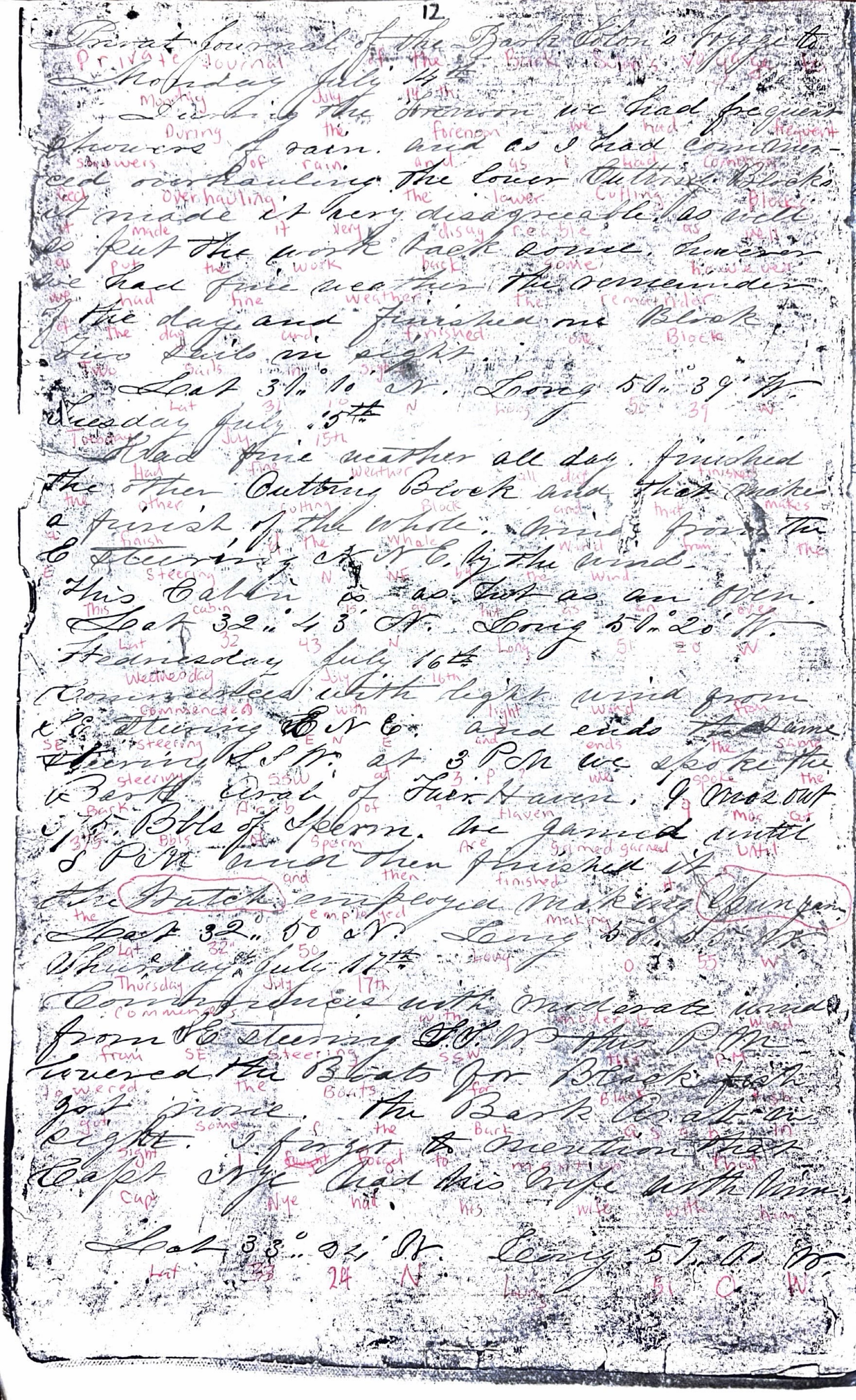
Private Journal of the Bark Solon’s Voyage to
Monday July 14th
During the forenoon we had frequent showers of rain and as I had commenced overhauling the lower cutting Blocks it made it very disagreeable as well as put the work back some. However we had fine weather the remainder of the day and finished one Block. Two sails in sight.
Lat 31 10 N Long 50 39 W1
Tuesday July 15th
Had fine weather all day. Finished the other cutting Block and that makes a finish of the whole. Wind from the E. steering N. NE. by the wind. This cabin is as hot as an oven.
Lat 32: 43” N Long. 51 20 W
Wednesday July 16th
Commences with light wind from SE steering ENE and ends the same. Steering SSW, at 3 PM. We spoke the Bark Arab of Fair Haven. 9 mos out 375 Bbls of Sperm. Are gamed2 until 8 PM and then finished it. the Watch employed making Spun Yarn
Lat 32 50 N Long 50 55 W
Thursday July 17th
Commences with moderate wind from SE steering S.SW this PM. Lowered the Boats for Blackfish3 got some. The Bark Arab4 in sight. I forgot to mention that Capt Nye5 had his wife with him.
Lat 33 24 N Long 51 O W
1 This is open ocean—part of the Sargasso Sea region, though a bit on its southern edge. It lies along common historic whaling grounds and shipping lanes between the Caribbean / Gulf Stream area and the mid-Atlantic.
2 When two whaleboats meet and communicate it is called a “gam”. Melville’s Moby Dick, Chapter 53 “The Gam” (see comments from Bob Fitch)
3 Pilot Whales
4 Bark Arab was one of the long-working Yankee whaling vessels of the 19th century, sailing mainly out of Fairhaven and later New Bedford, Massachusetts. Built in Bath, Maine, in 1823, she was a three-masted bark of about 271 tons, sturdy, practical, and well suited to long ocean passages.
5 Captain Joseph P. Nye was a New Bedford/Fairhaven whaling master active in the mid-19th century, part of the wider Nye maritime family that appears throughout the American whaling industry. He is best known today for his command of the Bark Arab on her 1861–1862 Atlantic voyage, a particularly challenging period in whaling history. Nye sailed Arab from Fairhaven on October 16, 1861, navigating the wartime Atlantic at a time when Confederate raiders were destroying American whalers. Despite these hazards, he brought Arab home safely on September 24, 1862, carrying a notable cargo of 447 barrels of sperm oil. After her return, Arab was sold to New Bedford owners to help replace losses such as the whaler Alert (sunk by the Confederate raider Alabama). Nye’s voyage is remembered as one of the last successful peacetime-style Atlantic cruises before the Civil War permanently reshaped the industry.
