September 26-28, 1862
pg. 24 of 39
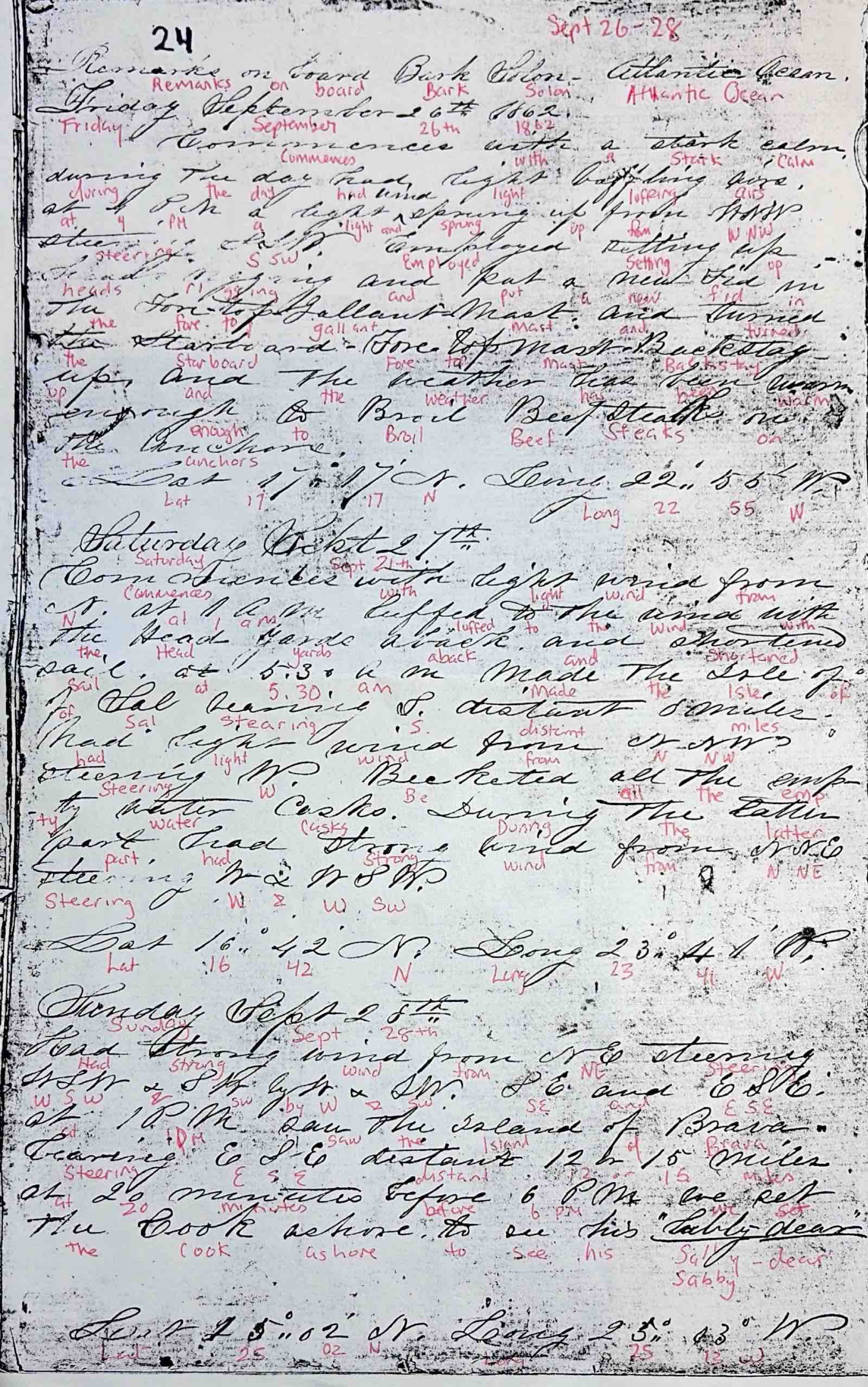
Remarks on board Bark Solon - Atlantic Ocean
Friday September 26th 1862
Commences with a stark calm1. During the day had light luffing2 airs. At 4 pm a light sprung up from W NW. Steering S SW. Employed setting up heads rigging and put a new fid3 in the fore-top gallant mast. And turned the starboard Fore top mast Backstay4 up. And the weather has been warm enough to Broil Beef Steaks on the anchors.
Lat 17 17 N Long 22 55 W
Saturday Sept 27th
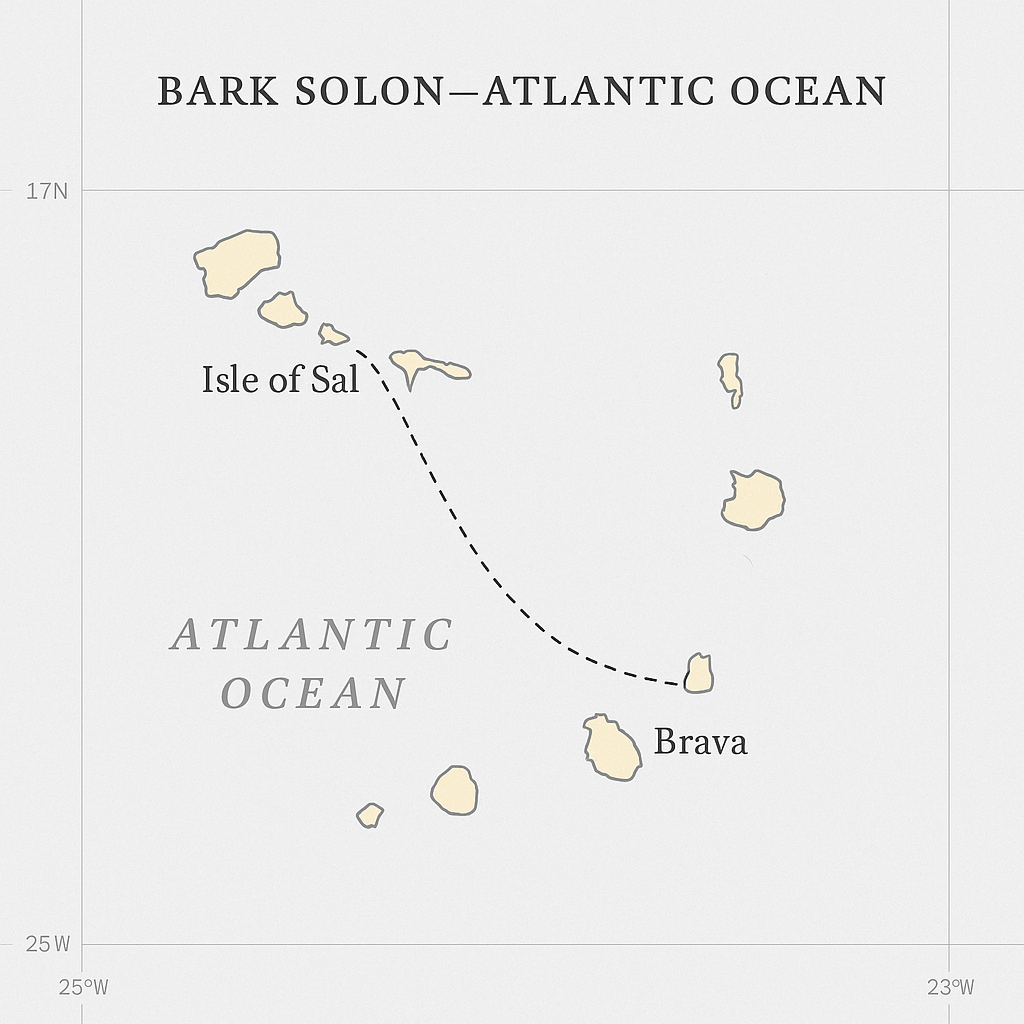
Commences with light wind from N at 1 am. Luffed to the wind with the Head Yards aback and shortened sail at 5:30 am. Made the Isle of Sal5. Steering S. distant 5 miles had light wind from N NW. Steering W. Becketed6 all the empty water casks. During the latter part had strong wind from N NE. Steering W & W SW.
Lat 16 42 N Long 23 41 W
Sunday Sept 28th
Had strong wind from NE. Steering WSW & SW by W. & SW. SE and ESE At 1 pm saw the Island of Brava7. Steering E SE distant 12 or 15 miles at 20 minutes before 6 pm. We set the Cook ashore to see his “Sabby-dear.8”
Lat 15 02 N Long 25 13 W
“Stark Calm” means absence of wind. For a square-rigged vessel this meant loss of steergeway and often oppressive heat, especially in low latitudes.
“Luffing” indicate the wind direction was unstable, causing sails to flap (luff) rather than draw steady.
Fid is a strong wooden or metal pin used to support a mast or spar or lock sections of a mast together.
A standing stay running aft from the fore topmast to the ship’s side, countering forward pull from sails. “Turned up” means tightened using deadeyes or lanyards to rebalance rig tension.
Sal itself was arid and sparsely populated, but it functioned as a navigational marker within the island chain.
Becketed water casks means securing with loops of rope or leather so casks cannot roll.
Brava (Ilha Brava) is the southwesternmost island of Cape Verde, historically known as the green island because it is more fertile than Sal. In the 19th century it was a familiar and socially connected landfall for whalers, with small anchorages such as Fajã d’Água, where shore relationships, provisioning, and brief leave were common.
“Sabby-dear” The term “Sabby” is best understood as a phonetic English rendering of Portuguese-based Creole speech, most likely Cape Verdean Creole (Kriolu). It derives from Portuguese saber (“to know”), commonly heard in forms such as sabe, which in creole usage is frequently reduced to sabi or sab’. English-speaking sailors regularly transcribed unfamiliar speech by sound, producing spellings such as sabby, closely related to the maritime loanword “savvy.” In this context, the mixed phrase “Sabby-dear” reflects everyday code-switching in 19th-century Atlantic port communities and likely denotes an affectionate personal relationship rather than a literal translation.
