United States v. John T. Duntlin (Case No. 2716)
Summary of 33 pages of Case 2716
Dear Readers,
Yesterday I received the pdf file of the Case against John T. Duntlin. With the assistance of my trusty assistant Chatgpt I have been through the case and the following sums up what I learned. At this point I think it is likely that this is the same John T Duntlin, my great great grandfather, who kept a personal journal while serving as first mate on the Bark Solon (1862-1863). The time line works with regard to what else I have found out about his life. The years of 1856-57 are unaccounted for in what I previously posted about his life. Duntlin married his first wife Ann P. Southack on August 25, 1854. The years between 1854 and 1862 (when he was on the Bark Solon) are without events. The following places him upon the ship Joshua Mauran. I have yet to find information about that particular voyage of the Joshua Mauran. I’ll keep searching. Meanwhile here is what I now know about the charge of murder on the high seas.
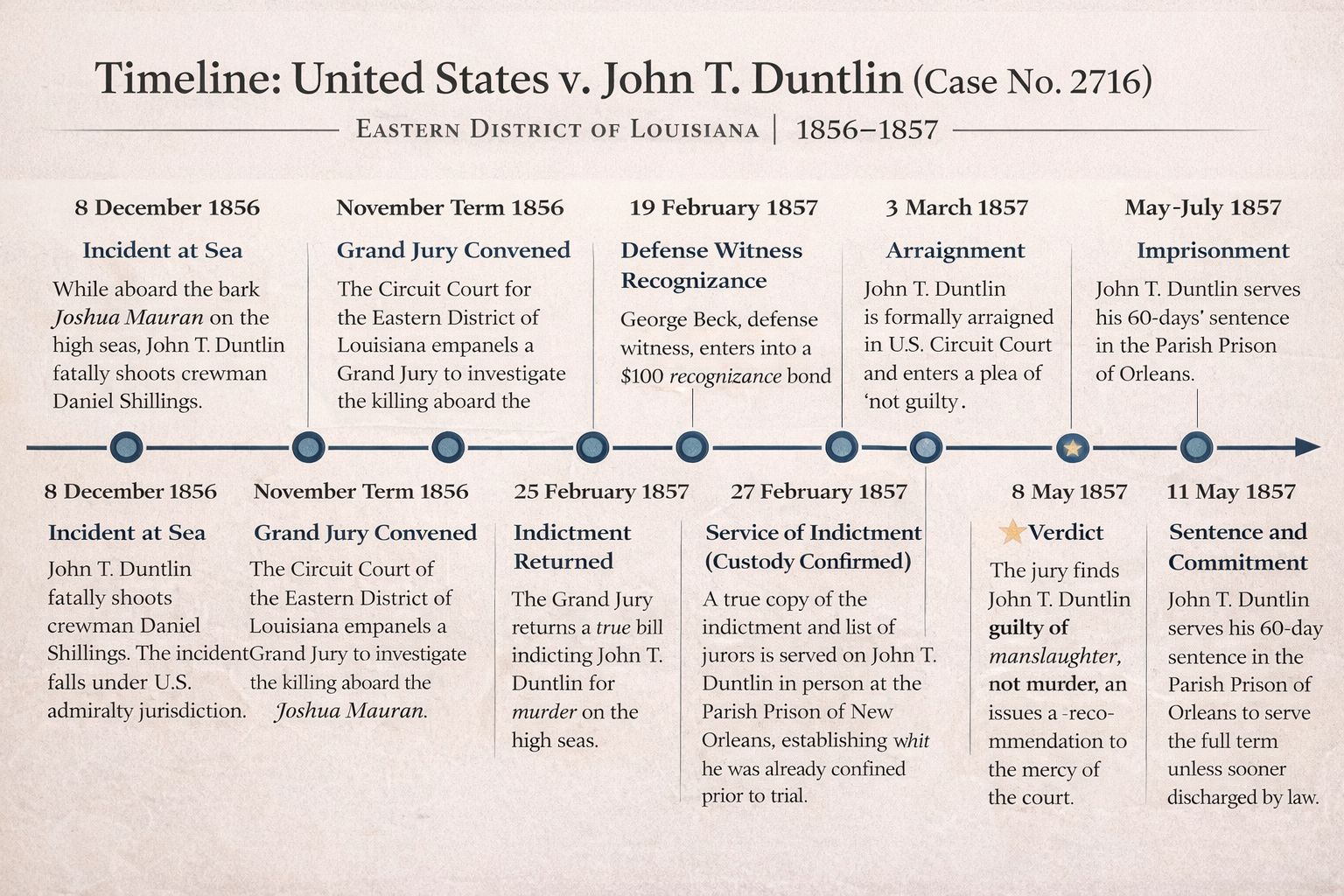
Eastern District of Louisiana, 1856–1857
Manslaughter on the High Seas – Bark Joshua Mauran
In the November Term of 1856, the Grand Jury of the United States Circuit Court for the Eastern District of Louisiana began proceedings against John T. Duntlin, a seaman and officer of the bark Joshua Mauran. The charge arose from an incident at sea on 8 December 1856, during which Duntlin fatally shot Daniel Shillings, a fellow crew member, aboard the vessel while it was on the high seas and thus within the admiralty and maritime jurisdiction of the United States.
On 25 February 1857, during the February Term of court, the Grand Jury returned a true bill indicting Duntlin for murder on the high seas. Witnesses for the United States—including Robert Bell, William Davis, Robert Wallace, James Brown, John White, and Robert Hill, all former employees of the Joshua Mauran—were sworn before the Grand Jury. Because these witnesses failed to give security for their appearance, they were ordered into custody pending trial.
Court records establish that John T. Duntlin was already in custody at this stage. The marshal’s return explicitly records that on 27 February 1857, a true copy of the indictment and the list of jurors was served upon Duntlin in person at the Parish Prison of New Orleans. This confirms that he was confined there prior to trial.
Defense preparations proceeded simultaneously. George Beck, identified as a witness for the defense, entered into a recognizance bond of $100 on 19 February 1857, binding himself to appear before the Circuit Court on 25 February 1857 to testify in the case of United States v. John T. Duntlin. When Beck failed to appear as required, the court issued attachment process against him for contempt, later documenting service and compliance.
On 3 March 1857, Duntlin was arraigned and entered a plea of not guilty. The case proceeded to trial, and on 8 May 1857, the jury returned a verdict finding him guilty of manslaughter, with an express recommendation to the mercy of the court—a critical distinction from the original charge of murder.
Following the verdict, the court issued a formal commitment on sentence. On 11 May 1857, the United States Marshal was commanded to convey Duntlin to the Parish Prison of Orleans, there to be confined for sixty days’ imprisonment, the punishment imposed for manslaughter under federal law at that time. The keeper of the Parish Prison was ordered to receive him and hold him safely for the full term, unless sooner discharged by due course of law.